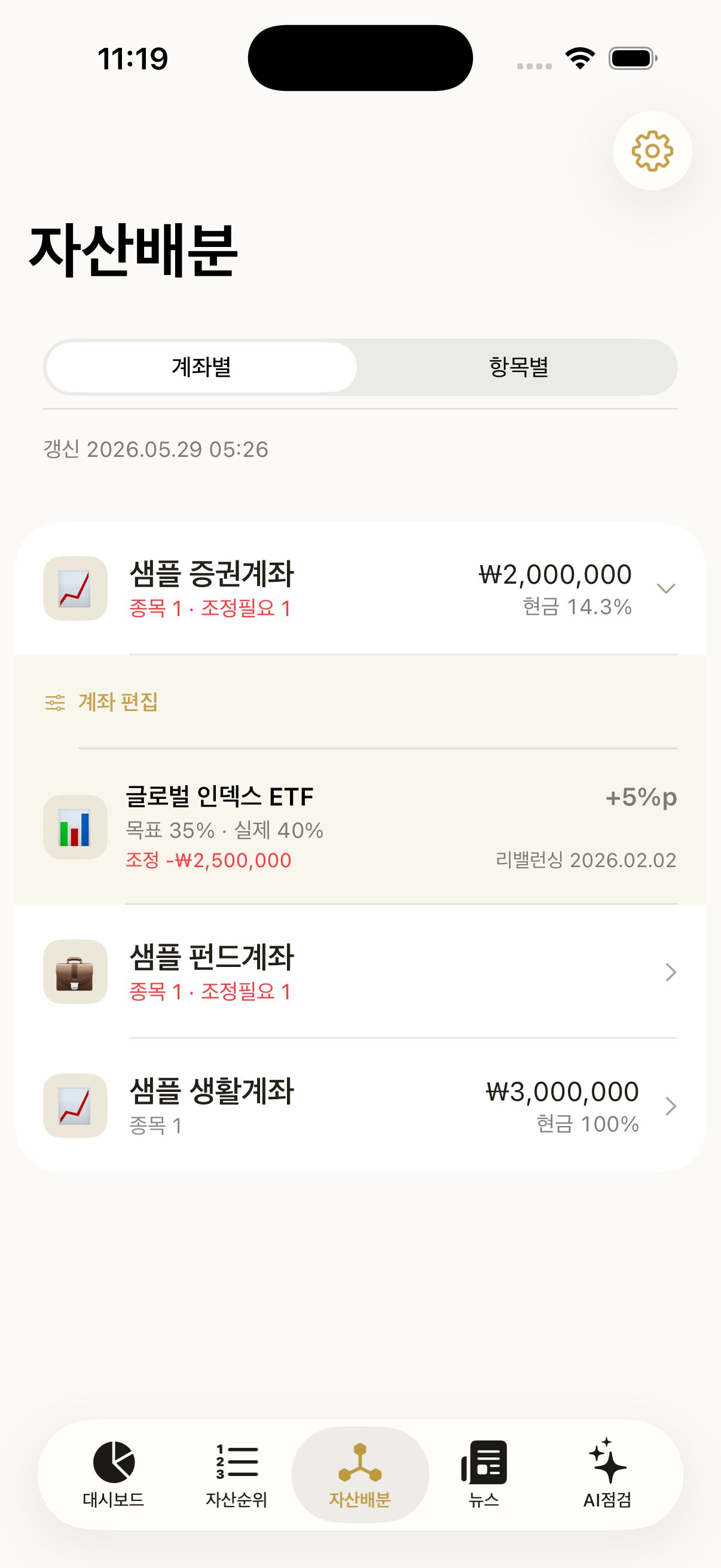
Works with: the sample · your own assets (editing target weights only when you enter your own assets)
What you see
One card per class. On the bar, the dark tick is the target and the filled colour is where you are.
- Above the target it says trim; below it, add — with the amount.
- The target and current figures carry amounts —
Target 35% · ₩17.5M/Now 40% · ₩20M. With percentages alone, nothing on screen says 35% of what. - Classes inside the range fold into one line —
Cash target 10% · ₩5M · same as now. - The order is fixed, biggest gap first. There is no sort to choose.
- Tapping an adjustment row opens that holding's screen — deciding how much to trim means looking at today's price.
One threshold, in one place
The threshold lives at Settings > My assets > Adjust when off by, and nowhere else. The pp badge on the Assets screen and the list here use the same value. Set per screen, you end up with “three need adjusting but nothing is marked”.
One account at a time
Coming in from an account shows only that account. Tapping into your brokerage account and being told about your fund account breaks the thread. Inside an account the holding is pinned down, so it goes as far as share counts — about 2.5 of 12 shares. See the full plan at the bottom widens it again.
After you trade
The app does not place orders. Update the quantity and average cost in account editing to match what you bought or sold in your brokerage app. The plan recalculates the moment you do.
Editing target weights
When you enter your own assets, the account editing screen changes quantity, average cost, target weight and cash balance in one place. Open it with Edit in the account, or from Settings > My assets > Accounts.
- Add holdings by search; anything search does not carry (cash · deposits · savings plans · real estate · bonds · funds) is picked from a list.
- Cash takes a target weight too — put a target % on the cash row and it counts in the total.
- If you changed target weights, the account has to add up to 100% to save (changing quantities alone has no such limit).
- Holdings with no target still appear, at 0%.
- To move several accounts' targets at once, use adjust weights across accounts at the bottom of Settings > My assets > Accounts.
When another device got there first
If the same holding was changed differently on two devices, saving asks which one to keep. Changes to different holdings are already merged, so you are only asked about what really diverged. You cannot close without choosing — that would leave the edit neither saved nor discarded.
Rebalancing plan
The app does not place orders. It builds a plan of what to buy and sell, and you place the orders yourself in your brokerage app. Check off what you ran and your holdings and records line up.
1. Build the plan
Pick the holdings, choose how many rounds (1 · 3 · 5) and the interval (at once · 1 day · 7 days · a month · your own), and it works out quantities and amounts per sell and buy leg, down to the cash you would have left.
- Sells are worked out first to raise the money, and the buys are filled from it.
- It only adjusts inside one account. Nothing moves between accounts.
2. Save it → in progress
Save the plan and it stays on the adjustment screen as an in progress banner. It survives quitting the app, and tapping the banner reopens it any time.
If you set an interval, a notification arrives at 9:05 in the morning on each round's due date. Tapping it opens that plan (you have to allow notifications once for this).
3. Run it and check it off
Place the orders in your brokerage app, come back, and check them.
- Tap done on a holding, or check the whole round if you ran the round in one go.
- Checking updates your quantity, average cost and cash (when you enter your own assets). Skip it and your ledger keeps the old quantity, so the next plan is built on holdings that are wrong.
- Average cost is re-weighted on buys only; sells leave it alone. The app cannot know your fill price, so it records the plan's expected price.
- Check every line in a round and it moves to the next; finish them all and the banner goes away.
4. Look back
Records on the adjustment screen stacks them by plan. Date, account, count and the sell/buy totals are folded up; open one and you see the round, price and amount. Scheduled notifications are listed there too, and tapping one goes to its plan.
Records are kept on this device only (checked something by mistake? press and hold to delete).
What the weight divides by
The denominator for your actual weight is the account total including its cash. Leave cash out and holding a lot of it makes your stock weights look higher than they are.
This screen works out the gap. You place the orders yourself, at your broker.